
[속보] 백악관도 한미 공동 팩트시트 발표…핵잠 건조 승인

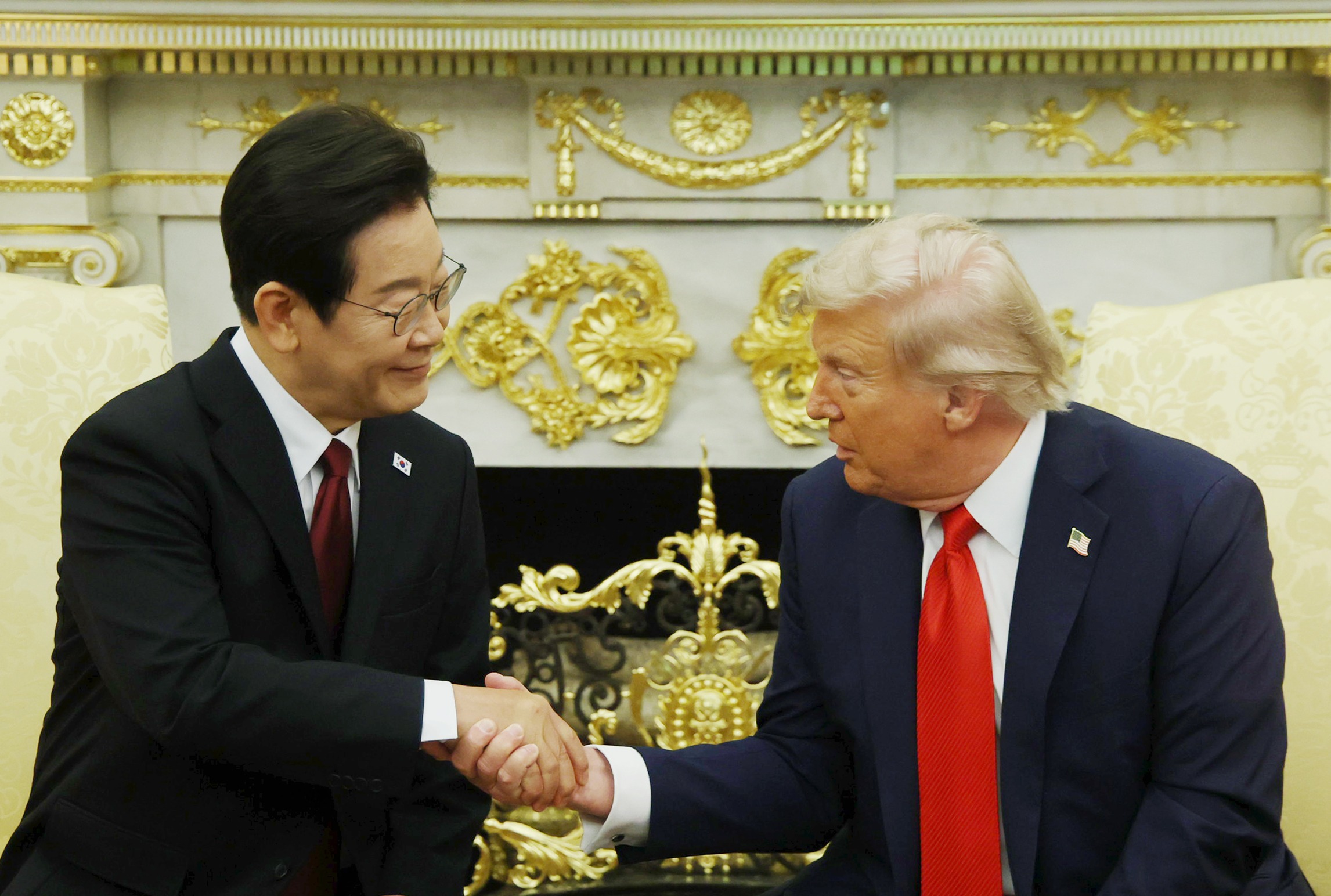
이하는 백악관이 공개한 팩트시트 전문을 번역한 내용으로, 한국 정부가 공개하는 공동 팩트시트 내용과 단어 및 표현에서 일부 차이가 있을 수 있음.
===
대한민국(ROK) 이재명 대통령은 10월 29일 도널드 J. 트럼프 미국(United States 또는 U.S.) 대통령의 국빈 방문을 환영했다. 이는 한국 역사상 처음으로 경주에서 국빈 방문이 개최된 것이며, 양국 정상 간 8월 25일 워싱턴에서의 첫 회담에 이은 것이다. 특히, 동일한 지도자를 두 번째 국빈 방문으로 맞이한 것도 이번이 처음이다.
트럼프 대통령의 역사적인 2024년 재선 승리와 한국의 민주주의적 강인함과 회복력을 보여준 이재명 대통령의 당선을 계기로, 양국 정상은 한반도 및 인도-태평양 지역의 평화, 안보, 번영의 핵심 축인 한미 동맹의 새로운 장을 열겠다고 선언했다.
핵심 산업 재건 및 확대:
트럼프 대통령과 이 대통령은 한미 동맹의 강인함과 지속성을 반영하는 '한미 전략적 무역·투자 협정'의 7월 역사적 발표를 재확인했다.- 양국 정상은 조선, 에너지, 반도체, 제약, 핵심 광물, 인공지능/양자 컴퓨팅 등 경제 및 국가 안보 이익 증진을 위한 한국의 다양한 분야 투자를 환영한다.
- 이 협정에는 미국이 승인한 조선 분야 1,500억 달러 규모의 한국 투자(승인 투자)가 포함된다.
- 또한 이 협정에는 미국과 한국 대표가 서명할 예정인 전략적 투자에 관한 양해각서(MOU)에 따라 추가로 약속된 2,000억 달러 규모의 한국 투자가 포함된다.
- 미국은 2025년 4월 2일자 개정된 행정명령 14257호에 따른 상호 관세 적용 목적상, 한국산 원산지 상품에 대해 한미자유무역협정(KORUS FTA) 또는 미국 최혜국(MFN) 관세율 중 높은 관세율을 적용하거나, 또는 15%의 관세율을 적용할 것이다. 이는 개정된 2025년 4월 2일자 행정명령 14257호에 따른 상호 관세 적용을 위한 조치이다.
- 미국은 한국의 자동차, 자동차 부품, 목재, 제재목 및 목재 파생품에 대한 232조 부문별 관세를 15%로 인하한다. 해당 한국 제품에 적용되는 한미 FTA 또는 MFN 관세율이 15% 이상인 경우, 추가적인 232조 관세는 적용되지 않는다. 한미 FTA 관세 또는 최혜국 대우 관세(적용 가능한 경우)가 15% 미만인 한국산 제품의 경우, 한미 FTA 관세 또는 최혜국 대우 관세와 추가 232조 관세의 합계는 15%가 된다.
- 의약품에 부과되는 제232조 관세의 경우, 미국은 한국산 원산지 상품에 대해 15%를 초과하지 않는 제232조 관세율을 적용할 의도이다.
- 반도체(반도체 제조 장비 포함)에 부과되는 제232조 관세의 경우, 미국은 한국에 대한 해당 제232조 관세 조건이 향후 체결될 수 있는 협정에서 제시될 수 있는 조건보다 불리하지 않도록 할 예정이며, 해당 협정은 미국이 판단하는 바에 따라 한국과 동등하거나 그 이상의 반도체 교역 규모를 포괄할 것이다.
- 미국은 2025년 4월 2일자 행정명령 14257호(개정)에 따라 부과된 추가 관세를, 제네릭 의약품, 제네릭 의약품 원료, 제네릭 의약품 화학 전구체, 미국에서 구할 수 없는 특정 천연자원 등 '협력국 대상 관세 조정 가능 품목 목록'에 명시된 특정 제품에 대해서는 철회할 예정입니다. 미국은 또한 개정된 대통령령 14257호, 개정된 대통령 선언 9704호, 개정된 대통령 선언 9705호 및 대통령 선언 10962호에 따라 부과된 관세에서 특정 항공기 및 한국산 부품에 대한 관세를 철폐할 것이다.
외환시장 안정성:
미국과 한국은 양국 간 양해각서(MOU)에 포함된 각자의 약속과 관련하여, 해당 양해각서가 한국의 외환시장 안정성에 미칠 수 있는 잠재적 영향에 대해 철저히 논의했다. 양국은 양해각서의 약속이 시장 불안정을 초래하지 않도록 해야 한다는 상호 이해에 도달했다. 신뢰받는 파트너로서 양국은 한국이 어느 한 해에 200억 달러를 초과하는 총액의 미국 달러를 조달할 의무가 없음을 합의한다. 한국은 시장에 미칠 수 있는 잠재적 영향을 최소화하기 위해 가능한 최대 범위 내에서 시장 매입 이외의 수단을 통해 미국 달러를 조달하기 위해 최선을 다할 것이다. 양해각서 이행이 원화 등 시장 불안정성을 초래할 수 있다고 판단될 경우, 한국은 자금 조달 규모 및 시기의 조정을 요청할 수 있으며, 미국은 이러한 요청을 성실히 검토할 것이다.상업적 유대 강화:
양국 정상은 양자 간 강력한 경제 협력에 대한 민간 부문의 신뢰를 반영하는 전략적 분야의 일련의 상업적 약속을 환영했다.- 양국 정상은 트럼프 대통령 임기 중 한국 기업들이 미국에 총 1,500억 달러 규모의 해외 직접 투자를 발표할 것이라고 밝힌 것을 환영했다. 양국은 이러한 투자를 촉진하기 위해 최선을 다할 것이다.
- 양국 정상은 8월 대한항공(KAL)이 GE 에어로스페이스 엔진이 장착된 보잉 항공기 103대를 구매하기로 한 발표를 환영했다. 이번 보잉 계약 규모는 360억 달러로, 보잉 737 MAX, 787 드림라이너, 777X 여객기 및 화물기 등이 포함되며, 이로써 2025년까지 KAL의 보잉 항공기 총 주문량은 150대 이상으로 늘어날 전망이다.
- 미국과 한국은 Buy America in Seoul 이니셔티브를 환영한다. 이 계획에 따라 한국은 주정부와 협력하여 중소기업을 포함한 미국 기업들을 대상으로 한 연례 전시회를 개최하여 미국 제품의 한국 수출을 촉진할 예정이다.
상호 무역 증진:
양국 정상은 최근 발표된 협정이 상호 이익이 되는 무역 및 투자 증대라는 공동 목표를 반영한다고 인정했다. 협정의 취지에 따라 미국과 한국은 비관세 장벽을 해결하고 상호 무역 증진을 위한 약속과 실행 계획을 문서화하여 연말까지 한미합동위원회에서 채택할 예정이다. 여기에는 다음 사항이 포함되나 이에 국한되지 않는다:- 한국은 추가 개조 없이 한국에 수입 가능한 미국산 연방자동차안전기준(FMVSS) 준수 차량에 대한 5만 대 수입 한도를 폐지할 것이다. 또한 한국은 미국 인증 기관에 제출된 서류 외에 배출가스 인증 과정에서 추가 서류를 요구하지 않음으로써 미국 자동차 수출에 대한 규제 부담을 경감할 것이다.
- 한국은 미국과 협력하여 식품 및 농산물 무역에 영향을 미치는 비관세 장벽을 해결할 것이며, 이를 위해 다음을 포함하되 이에 국한되지 않을 것이다: 양자 협정 및 의정서 하의 기존 약속 이행 보장; 농산물 생명공학 제품에 대한 규제 승인 절차를 간소화하고 미 처리 중인 미국 신청 건을 해결하며; 미국 원예 제품 관련 요청을 전담하는 '미국 데스크'를 신설하고; 특정 용어를 사용하는 미국산 육류 및 치즈의 시장 접근성을 유지한다.
- 미국과 한국은 네트워크 사용료 및 온라인 플랫폼 규제를 포함한 디지털 서비스 관련 법률·정책 측면에서 미국 기업이 차별받거나 불필요한 장벽에 직면하지 않도록 보장하고, 위치·재보험·개인정보 등 데이터의 국경 간 이동을 용이하게 할 것을 약속한다. 또한 양국은 세계무역기구(WTO)에서 전자 전송에 대한 관세 부과를 영구적으로 유예하는 조치를 지지할 것이다.
- 대한민국은 경쟁 절차에서 변호사-의뢰인 비밀유지권 인정을 포함한 추가적인 절차적 공정성 조항을 제공하기로 약속한다.
- 미국과 대한민국은 지식재산권 보호를 위해 협력할 것이다. 대한민국은 특허법 조약(PCT) 가입을 위해 필요한 조치를 계속 취할 것이다.
- 미국과 대한민국은 국제적으로 인정된 노동권에 대한 강력한 보호를 보장하기 위해 협력하기로 약속한다. 미국과 한국은 강제 노동으로 생산된 상품의 수입을 차단하는 등 전 세계적으로 모든 형태의 강제 노동을 근절하기 위해 협력할 것이다.
- 미국과 한국은 환경 보호 차이로 인해 무역과 투자가 왜곡되지 않도록 하는 것이 중요함을 재확인한다. 이를 위해 한국은 상호 무역을 촉진하기 위해 환경 법규를 효과적으로 집행할 것이며, 여기에는 WTO 어업 보조금 협정의 완전한 이행도 포함된다.
경제적 번영 보호:
양국 정상은 경쟁력을 유지하고 안전한 공급망을 확보하기 위해 경제 및 국가 안보 협력 강화를 필요로 한다는 점을 인정했다. 여기에는 관세 회피 방지 협력, 불공정·비시장적 정책 및 관행 대응을 위한 상호 보완적 조치, 해외 투자 및 국내 투자 규제 개선 등이 포함된다. 양국은 국제 조달 의무가 동일한 약속을 이행한 국가들에 혜택을 제공하도록 보장할 것이다.한미 동맹 현대화:
미국은 주한미군(USFK)의 지속적인 주둔을 통해 한국 방어에 대한 의지를 재확인했다.- 미국은 핵 능력을 포함한 전 역량을 활용하여 확장 억제를 제공하겠다는 약속을 재확인했다. 양국 정상은 핵협의단을 포함한 협의 메커니즘을 통한 협력 강화를 약속했다.
- 이 대통령은 한국 법률 요건에 따라 가능한 한 조속히 국방비를 국내총생산(GDP)의 3.5%로 증액할 계획임을 공유했으며, 트럼프 대통령은 이를 환영했다.
- 한국은 또한 2030년까지 250억 달러 규모의 미국 군사 장비 구매를 약속했으며, 한국 법률 요건에 따라 주한미군에 330억 달러 규모의 포괄적 지원을 제공할 계획임을 공유했다.
- 양국 정상은 전시작전권 이양을 위한 동맹 협력을 지속하기로 약속했다. 한국의 군사 역량 강화 노력을 가속화하겠다는 한국의 약속은 미국의 지원을 바탕으로, 조선민주주의인민공화국(북한)에 대한 연합 상비 방어 주도권 확보에 필요한 군사 역량 강화에 초점을 맞춘다. 여기에는 첨단 미국 무기 체계 도입 및 첨단 무기 체계 분야를 포함한 양국 방산 협력 확대가 포함된다.
- 미국과 한국은 북한을 포함한 동맹에 대한 모든 지역적 위협에 대한 미국의 재래식 억지 태세를 강화할 것이다. 양측은 2006년 이후의 관련 합의를 재확인한다. 양측은 긴밀한 협의를 지속하고 이행 진척 상황을 각국 지도부에 보고할 것이다.
- 미국과 한국은 사이버 공간 및 우주 공간에서의 협력을 확대하기로 약속했다. 양국 정상은 군사 분야 인공지능(AI)에 관한 공동 작업을 지속할 의향도 재확인했다.
한반도 및 지역 현안에 대한 협력:
양국 정상은 한반도와 인도태평양 지역의 평화, 안보, 번영을 위해 노력하기로 약속했다.- 양국 정상은 북한의 완전한 비핵화와 한반도의 평화와 안정에 대한 의지를 재확인하고, 2018년 미·북 싱가포르 정상회담 공동성명 이행을 위해 협력하기로 약속했다.
- 양국 정상은 북한 정책에 대해 긴밀히 협력하기로 합의하고, 북한이 대량살상무기(WMD) 및 탄도미사일 프로그램을 포기하는 등 국제적 의무를 준수하며 의미 있는 대화에 복귀할 것을 촉구했다.
- 양국 정상은 일본과의 3국 간 협력 관계를 강화하기로 약속했다.
- 양국 정상은 항행·상공 비행의 자유 및 기타 합법적 해양 이용을 수호하기 위한 노력을 재확인했다. 모든 국가의 해양 주장은 국제 해양법에 부합해야 함을 재확인했다.
- 양국 정상은 대만 해협 전역의 평화와 안정 유지의 중요성을 강조했다. 양안 문제의 평화적 해결을 장려하고 현상 일방적 변경에 반대했다.
해양 및 원자력 협력 강화:
미국은 한국이 미국 조선소 및 인력에 대한 투자를 포함해 미국 조선 산업의 현대화 및 역량 확장에 기여하겠다는 약속을 환영했다. 한국은 미국의 한국 민간 및 군용 원자력 발전 프로그램 지원을 환영했다.- 양국은 조선 작업반을 통해 유지보수, 수리 및 정비, 인력 개발, 조선소 현대화, 공급망 회복탄력성 등 분야에서 추가 협력을 추진하기로 했다.
- 이러한 노력은 한국 내 미국 선박 건조 가능성을 포함해 미국 상선 및 전투 준비 태세 미군 함정의 수를 최대한 신속히 증대시킬 것이다.
- 양국 간 123협정에 부합하고 미국의 법적 요건을 충족하는 범위 내에서, 미국은 평화적 이용을 위한 한국의 민간 우라늄 농축 및 사용후핵연료 재처리 과정 추진을 지지한다.
- 미국은 한국이 핵추진 공격형 잠수함을 건조하는 것을 승인했다. 미국은 연료 조달 방안을 포함해 이 조선 프로젝트의 요건 추진을 위해 한국과 긴밀히 협력할 것이다.
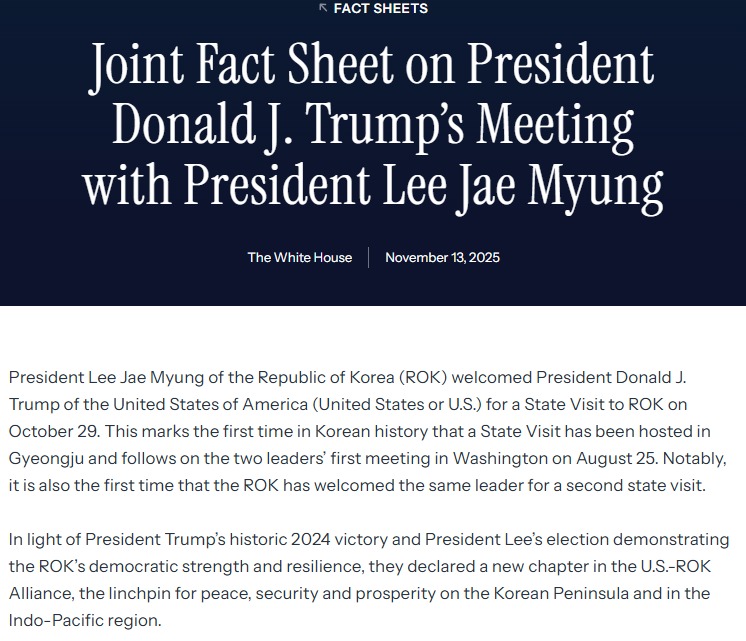
백악관이 공개한 팩트시트 원문.
President Lee Jae Myung of the Republic of Korea (ROK) welcomed President Donald J. Trump of the United States of America (United States or U.S.) for a State Visit to ROK on October 29. This marks the first time in Korean history that a State Visit has been hosted in Gyeongju and follows on the two leaders’ first meeting in Washington on August 25. Notably, it is also the first time that the ROK has welcomed the same leader for a second state visit.In light of President Trump’s historic 2024 victory and President Lee’s election demonstrating the ROK’s democratic strength and resilience, they declared a new chapter in the U.S.-ROK Alliance, the linchpin for peace, security and prosperity on the Korean Peninsula and in the Indo-Pacific region.
REBUILDING AND EXPANDING CRITICAL INDUSTRIES: President Trump and President Lee reaffirmed the historic announcement in July of The Korea Strategic Trade and Investment deal, which reflects the strength and endurance of the U.S.-ROK Alliance.
Both leaders welcome Korean investments in various sectors to advance economic and national security interests, including but not limited to shipbuilding, energy, semiconductors, pharmaceuticals, critical minerals, and artificial intelligence/quantum computing.
This deal includes $150 billion of Korean investment in the shipbuilding sector approved by the United States, which is referred to as the Approved Investments.
This deal also includes $200 billion of additional Korean investment committed pursuant to the Memorandum of Understanding with respect to Strategic Investments (MOU), which is expected to be signed by representatives of the United States and ROK.
The United States will apply the higher of either the U.S.-Korea Free Trade Agreement (“KORUS FTA”) or U.S. Most Favored Nation (“MFN”) tariff rate, as applicable, or a tariff rate of 15 percent on originating goods of the ROK, for purposes of the reciprocal tariff provided under Executive Order 14257 of April 2, 2025, as amended.
The United States will reduce its Section 232 sectoral tariffs on automobiles, auto parts, timber, lumber, and wood derivatives of the ROK to 15 percent. For such products of the ROK with a KORUS FTA or MFN tariff rate, as applicable, equal to or greater than 15 percent, no additional Section 232 tariff shall apply. For such products of the ROK with a KORUS FTA or MFN tariff, as applicable, less than 15 percent, the sum of the KORUS FTA or MFN tariff and the additional Section 232 tariff shall be 15 percent.
For any Section 232 tariffs imposed on pharmaceuticals, the United States intends to apply to originating goods of the ROK a Section 232 tariff rate no greater than 15 percent.
For any Section 232 tariffs imposed on semiconductors (including semiconductor manufacturing equipment), the United States intends to provide terms for such Section 232 tariffs on Korea that are no less favorable than terms that may be offered in a future agreement covering a volume of semiconductor trade at least as large as Korea’s, as determined by the United States.
The United States intends to remove supplemental tariffs imposed pursuant to Executive Order 14257 of April 2, 2025, as amended for certain products identified on the list of Potential Tariff Adjustments for Aligned Partners, such as generic pharmaceuticals, generic pharmaceutical ingredients, generic pharmaceutical chemical precursors, and certain natural resources unavailable in the United States. The United States will also remove tariffs on certain aircraft and parts of the ROK from the tariffs imposed pursuant to Executive Order 14257, as amended, by Proclamation 9704, as amended, Proclamation 9705, as amended, and Proclamation 10962.
FOREIGN EXCHANGE MARKET STABILITY: The United States and the ROK, in connection with their respective commitments included in the MOU, have thoroughly discussed the potential impact of the MOU on the foreign exchange market stability of the ROK. They have reached a mutual understanding that commitments in the MOU shall not be allowed to give rise to market instability. As trusted partners, the two nations agree that the ROK shall not be required to fund an aggregate amount of U.S. dollars greater than $20 billion in any calendar year. The ROK will use its best efforts, to the greatest extent possible, to source the U.S. dollars through means other than market purchases so as to minimize any potential impact on the market. Should it appear that the fulfillment of the commitments in the MOU may cause market instability, such as disorderly movements of Korean won, the ROK may request an adjustment in the amount and timing of the funding, and the United States will, in good faith, give due consideration to such request.
ENHANCING COMMERCIAL TIES: The two leaders welcomed a series of commercial commitments in strategic sectors, reflecting the confidence of the private sector in the strong bilateral economic partnership.
The two leaders welcomed the announcement in August by ROK companies of foreign direct investments in the United States totaling $150 billion during President Trump’s term. Both countries will use their best efforts to facilitate these investments.
The two leaders welcomed the announcement by Korean Air (KAL) in August of a purchase order of 103 Boeing aircraft powered by GE Aerospace engines. The Boeing commitment is valued at U.S. $36 billion and will include a mix of Boeing 737 MAX jets, 787 Dreamliners, and 777X passenger and freighters, bringing KAL’s total order in 2025 to more than 150 Boeing airplanes.
The United States and the ROK welcome the Buy America in Seoul initiative, whereby the ROK, in collaboration with the State Governments, will organize an annual exhibition featuring U.S. companies, including Small and Medium-sized Enterprises, to promote the export of U.S. goods into Korea.
PROMOTING RECIPROCAL TRADE: The two leaders recognized that the recently announced deal reflects a common goal to increase mutually beneficial trade and investment. In the spirit of the deal, the United States and the ROK will address non-tariff barriers and memorialize commitments and a plan of action to promote reciprocal trade, to be adopted by the KORUS Joint Committee before the end of the year. This will include but not be limited to the following:
The ROK will eliminate the 50,000-unit cap on U.S.-originating Federal Motor Vehicle Safety Standards (FMVSS)-compliant vehicles that can enter the ROK without further modifications. The ROK will also reduce regulatory burdens for U.S. automotive exports by not requiring additional documentation in its emissions certification process other than those submitted to U.S certification authorities.
The ROK will work together with the United States to address non-tariff barriers affecting trade in food and agricultural products, including by: ensuring that existing commitments under bilateral agreements and protocols are met; streamlining the regulatory approval process for agricultural biotechnology products and resolving the backlog of U.S. applications; establishing a U.S. Desk dedicated to requests for U.S. horticultural products; and preserving market access for U.S. meats and cheeses that use certain terms.
The United States and the ROK commit to ensure that U.S. companies are not discriminated against and do not face unnecessary barriers in terms of laws and policies concerning digital services, including network usage fees and online platform regulations, and to facilitate cross-border transfer of data, including for location, reinsurance, and personal data. Further, the United States and the ROK will support the permanent moratorium on customs duties on electronic transmissions at the World Trade Organization.
The ROK commits to provide additional procedural fairness provisions in competition proceedings, including the recognition of attorney-client privilege.
The United States and the ROK will work together to protect intellectual property rights. The ROK will continue to take the necessary steps to accede to the Patent Law Treaty.
The United States and the ROK commit to work together to ensure strong protection of internationally-recognized labor rights. The United States and the ROK will work together to combat all forms of forced labor globally, including by combatting the importation of goods made with forced labor.
The United States and the ROK reaffirm the importance of ensuring differences in environmental protection do not distort trade and investment. To this end, the ROK will effectively enforce its environmental laws to facilitate reciprocal trade, including by fully implementing the WTO Agreement on Fisheries Subsidies.
PROTECTING ECONOMIC PROSPERITY: The two leaders acknowledged the need to strengthen economic and national security alignment in order to preserve our competitiveness and maintain secure supply chains. This includes cooperation to combat duty evasion and taking complementary actions to address unfair and non-market policies and practices, enhancing inbound investment and outbound investment regulations, and both countries will ensure that international procurement obligations provide a benefit to those countries that have taken on the same commitments.
MODERNIZING THE U.S.-ROK ALLIANCE: The United States underscored its commitment to the defense of the ROK through the enduring presence of the U.S. Forces Korea (USFK).
The United States reaffirmed its pledge to provide extended deterrence, leveraging the full range of its capabilities, including nuclear. The two leaders committed to strengthening cooperation through consultation mechanisms including the Nuclear Consultative Group.
President Lee shared the ROK’s plan to increase its defense spending to 3.5% of GDP as soon as possible in accordance with ROK legal requirements, which President Trump welcomed.
The ROK also committed to spending $25 billion on U.S. military equipment purchases by 2030, and shared its plan to provide comprehensive support for U.S. Forces Korea amounting to $33 billion in accordance with ROK legal requirements.
The two leaders committed to continue alliance cooperation toward the transition of wartime operational control. With the support of the United States, the ROK pledged to accelerate efforts to strengthen its military capabilities necessary to lead the combined conventional defense against the Democratic People’s Republic of Korea (DPRK). These include acquisition of advanced U.S. weapons systems and expansion of bilateral defense industrial cooperation, including in high-tech weapons systems.
The United States and the ROK will enhance U.S. conventional deterrence posture against all regional threats to the Alliance, including the DPRK. The two sides affirm relevant understandings since 2006. Both sides will continue close consultation and report the progress on implementation to their leadership.
The United States and the ROK pledged to expand cooperation in cyberspace and outer space. The two leaders also reaffirmed their intention to continue working together on AI in the military domain.
COORDINATING ON KOREAN PENINSULA AND REGIONAL ISSUES: The two leaders committed to peace, security, and prosperity both on the Korean Peninsula and in the Indo-Pacific region.
The two leaders reiterated their commitment to the complete denuclearization of the DPRK and peace and stability on the Korean Peninsula, and pledged to work together to implement the Joint Statement of the 2018 U.S.-DPRK Singapore Summit.
Both leaders agreed to coordinate closely on DPRK policy and called on the DPRK to return to meaningful dialogue and abide by its international obligations, including by abandoning its weapons of mass destruction (WMD) and ballistic missile programs.
The two leaders committed to strengthen the trilateral partnership with Japan.
The two leaders reaffirmed efforts to uphold freedoms of navigation and overflight and other lawful uses of the sea. They reaffirmed that the maritime claims of all nations should comply with the international law of the sea.
They emphasized the importance of preserving peace and stability across the Taiwan Strait. They encouraged the peaceful resolution of cross-Strait issues and opposed unilateral changes to the status quo.
FURTHERING OUR MARITIME AND NUCLEAR PARTNERSHIP: The United States welcomed the ROK’s commitment to contribute to modernizing and expanding the capacity of American shipbuilding industries, including through investments in U.S. shipyards and America’s workforce. The ROK welcomed the United States’ support for the ROK’s civil and naval nuclear power programs.
Both countries committed to collaborate further through a shipbuilding working group, including on maintenance, repair, and overhaul, workforce development, shipyard modernization, and supply chain resilience.
These initiatives will increase the number of U.S. commercial ships and combat-ready U.S. military vessels as quickly as possible, including the potential construction of U.S. vessels in the ROK.
Consistent with the bilateral 123 agreement and subject to U.S. legal requirements, the United States supports the process that will lead to the ROK’s civil uranium enrichment and spent fuel reprocessing for peaceful uses.
The United States has given approval for the ROK to build nuclear-powered attack submarines. The United States will work closely with the ROK to advance requirements for this shipbuilding project, including avenues to source fuel.
워싱턴=이상은 특파원 selee@hankyung.com
ⓒ 한경닷컴, 무단전재 및 재배포 금지
ADVERTISEMENT

-
1
트럼프 "조선업은 한국이 전문가…제안대로 하자" [이상은의 워싱턴나우]
한미 양국이 14일(미국시간 13일) 발표한 공동 팩트시트 내용은 지난 8월 양측이 준비했던 팩트시트 내용과 상당부분 일치하는 것으로 나타났다. 다만 조선업 협력과 핵추진 잠수함 등 안보 분야에 관한 내용이 다수 추...
2025.11.14 18:03
![트럼프 "조선업은 한국이 전문가…제안대로 하자" [이상은의 워싱턴나우]](https://img.hankyung.com/photo/202511/01.42381031.3.jpg)
-
2
韓도 변호사-의뢰인 비밀유지권 인정…공정위 '압박조사'에 제동 [이상은의 워싱턴나우]
정부가 공정거래위원회 등이 기업을 조사할 때 사측과 변호사가 나눈 대화 내용을 비밀로 유지할 수 있는 ‘비닉특권(ACP·attorney client privilege)&rsq...
2025.11.14 16:25
![韓도 변호사-의뢰인 비밀유지권 인정…공정위 '압박조사'에 제동 [이상은의 워싱턴나우]](https://img.hankyung.com/photo/202511/01.42376613.3.jpg)
-
3
쌀·쇠고기 언급 없었다…한·미 합의에 '추가개방' 논의 안 담겨 [이상은의 워싱턴나우]
한미 양국이 14일(미국시간 13일) 발표한 공동 팩트시트에 따르면 양측은 '상호무역 촉진'이라는 목표 아래 비관세 장벽을 해소하기 위한 여러 조치에 합의했다. 이 중 대부분은 8월에 이미 양측이 거의...
2025.11.14 16:12
![쌀·쇠고기 언급 없었다…한·미 합의에 '추가개방' 논의 안 담겨 [이상은의 워싱턴나우]](https://img.hankyung.com/photo/202511/01.42380326.3.jpg)
ADVERTISEMENT